


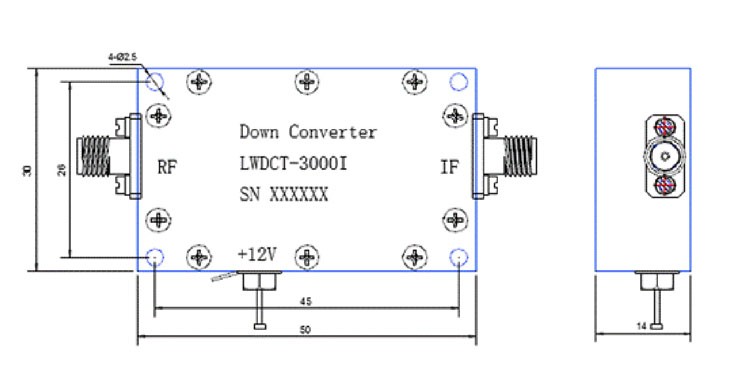
Digital Down Converter
Digital Down Converter COFDM Transfer frequency 2.4G to 600Mhz low

Selling Points
- Input frequencies from 24000 to 600MHz (Lower 1800Mhz)
- High bandwidth
- Low phase noise
- High-frequency stability

Specification
RF Frequency Range: 2400 Mhz
IF Frequency Range: 600 Mhz
Return Loss:-12 dB
Frequency Accuracy: ±10 ppm
Image Rejection: 60 dBc
Flatness: ±0.5 dB (8MHz bandwidth)
Conversion Gain: 25 dB
Phase Noise (dBc/Hz)
dBc/Hz@1KHz ≤-80
dBc/Hz@10KHz ≤-90
dBc/Hz@100KHz ≤-100
Supply Voltage: 10~15V
Power Current: 100 mA
Operating Temperature Range: +25 ℃

Port
RF IN: SMA-50K
IF OUT: SMA-50K
Power +12V: Stick
GND: Soldering lug
Note
- The converter does not need to add a low noise amplifier at the back end.
- Actual Test: closed-loop test under the frequency of 2.4GHz/bandwidth 4MHz, the receiving sensitivity can reach -105dBm.
- Input frequency supports 1~3GHz. (We can support customize).
- Output frequency supports 300~700MHz. (We can support customize).
FAQ
Question: My input frequency range would need to be 2.0Ghz to 2.7Ghz, downconverting to 200Mhz to 900Mhz. The conversion gain would ideally be 30db not 25db. Would this be easy for you to do?
Answer: Yes, we can customize for you.


What is DDC
In digital signal processing, a digital down-converter (DDC) converts a digitized, band limited signal to a lower frequency signal at a lower sampling rate in order to simplify the subsequent radio stages. The process preserves all the information in the original signal less that which is lost to rounding errors in the mathematical processes. The input and output signals can be real or complex samples. Often the DDC converts from the raw radio frequency or intermediate frequency down to a complex baseband signal.
Architecture
A DDC consists of three subcomponents: a direct digital synthesizer (DDS), a low-pass filter (LPF), and a downsampler (which may be integrated into the low-pass filter). The DDS generates a complex sinusoid at the intermediate frequency (IF). Multiplication of the intermediate frequency with the input signal creates images centered at the sum and difference frequency (which follows from the frequency shifting properties of the Fourier transform). The lowpass filters pass the difference (i.e. baseband) frequency while rejecting the sum frequency image, resulting in a complex baseband representation of the original signal. Assuming judicious choice of IF and LPF bandwidth, the complex baseband signal is mathematically equivalent to the original signal. In its new form, it can readily be downsampled and is more convenient to many DSP algorithms. Any suitable low-pass filter can be used including FIR, IIR and CIC filters. The most common choice is a FIR filter for low amounts of decimation (less than ten) or a CIC filter followed by a FIR filter for larger downsampling ratios.
Variations on the DDC
Several variations on the DDC are useful, including many that input a feedback signal into the DDS. These include:
- Decision directed carrier recovery phase locked loops in which the I and Q are compared to the nearest ideal constellation point of a PSK signal, and the resulting error signal is filtered and fed back into the DDS
- A Costas loop in which the I and Q are multiplied and low pass filtered as part of a BPSK/QPSK carrier recovery loop
Implementation
DDCs are most commonly implemented in logic in field-programmable gate arrays or application-specific integrated circuits. While software implementations are also possible, operations in the DDS, multipliers and input stages of the lowpass filters all run at the sampling rate of the input data. This data is commonly taken directly from analog to digital converters (ADCs) sampling at tens or hundreds of MHz. CORDICs are an alternative to the use of multipliers in the implementation of digital down converters.
Wireless Video transmitter and receiver, COFDM-904T is recommended.
Digital Down Converter – High-Performance COFDM Frequency Down Conversion for 2.4GHz to 600MHz
Overview
The Digital Down Converter (DDC) is an advanced frequency conversion module designed to meet the demanding requirements of modern wireless communication, broadcasting, and surveillance applications. By converting higher frequency signals in the 2.0–3.0 GHz range into lower intermediate frequencies (IF) such as 300–700 MHz, this device provides engineers and system integrators with a reliable solution for long-range video, data, and control transmission systems.
With outstanding frequency accuracy, low phase noise, high conversion gain, and excellent image rejection, this down converter ensures that your COFDM-based communication systems deliver stable, clear, and interference-free performance in both professional and mission-critical environments.
Whether deployed in unmanned aerial vehicle (UAV) video downlinks, public safety wireless communication systems, digital broadcasting, or military-grade data transmission, this unit guarantees excellent reliability and adaptability. The DDC supports both standard frequency bands and customized ranges, making it a flexible tool for projects requiring specific RF-to-IF conversions.
Key Features
-
Wide Input Frequency Range: Supports input frequencies between 1–3 GHz, with optimized operation at 2.4 GHz.
-
Flexible Output Frequencies: Default IF output is 600 MHz, with support for customized ranges between 300–700 MHz.
-
High Conversion Gain: Standard 25 dB gain ensures strong signal integrity; customizable options available up to 30 dB.
-
Low Phase Noise: Exceptional phase noise suppression across multiple offsets:
-
≤ -80 dBc/Hz @ 1 kHz
-
≤ -90 dBc/Hz @ 10 kHz
-
≤ -100 dBc/Hz @ 100 kHz
-
-
High Image Rejection: Delivers 60 dBc image rejection for clean signal processing.
-
Frequency Stability: Maintains ±10 ppm frequency accuracy for precise communication links.
-
Broad Bandwidth & Flatness: ±0.5 dB flatness over 8 MHz bandwidth ensures high-quality transmission without distortion.
-
Energy Efficient: Operates on +12V DC supply with a typical current consumption of only 100 mA.
-
Robust Connectors: Equipped with SMA-50K connectors for both RF input and IF output.
Technical Specifications
-
RF Frequency Range: 2400 MHz (supports 1–3 GHz custom input)
-
IF Frequency Range: 600 MHz (supports 300–700 MHz custom output)
-
Return Loss: -12 dB
-
Frequency Accuracy: ±10 ppm
-
Image Rejection: 60 dBc
-
Flatness: ±0.5 dB (over 8 MHz bandwidth)
-
Conversion Gain: 25 dB (30 dB optional)
-
Phase Noise:
-
@1 kHz offset: ≤ -80 dBc/Hz
-
@10 kHz offset: ≤ -90 dBc/Hz
-
@100 kHz offset: ≤ -100 dBc/Hz
-
-
Supply Voltage: 10–15 V (typical 12 V)
-
Power Current: 100 mA
-
Operating Temperature: +25 ℃ (wide temperature customization available)
Ports
-
RF IN: SMA-50K
-
IF OUT: SMA-50K
-
Power Input: +12 V stick connector
-
Ground: Soldering lug
Real-World Performance
Laboratory and field testing confirm that the converter delivers exceptional results under demanding operating conditions.
-
In a closed-loop test at 2.4 GHz input with 4 MHz bandwidth, the receiving sensitivity was measured at -105 dBm, proving the module’s ability to maintain excellent signal quality even in low-SNR environments.
-
Due to its optimized architecture, the unit does not require an external low-noise amplifier (LNA) at the back end, reducing system complexity and improving overall reliability.
-
Designed with flexibility in mind, the module supports customizable frequency ranges both at the input and output, enabling system designers to integrate it seamlessly into existing or specialized RF systems.
Applications
The Digital Down Converter is a versatile tool suited for a wide range of professional and industrial applications.
1. Unmanned Aerial Vehicles (UAVs) & Drones
-
Enables long-distance video downlinks from drones to ground stations.
-
Provides stable COFDM-modulated video and telemetry transmission in real time.
-
Ensures low-latency, interference-resistant communication, critical for aerial surveillance, inspection, and mapping missions.
2. Public Security & Emergency Services
-
Used in mobile command centers for live video feeds from field units.
-
Assists in search and rescue operations, firefighting, and law enforcement by ensuring robust, low-latency wireless video transmission.
3. Military & Defense Applications
-
Ideal for reconnaissance, battlefield communication, and secure data links.
-
High stability and low phase noise guarantee interference-free operation in contested environments.
-
Works seamlessly with COFDM-based tactical video transmitters and receivers.
4. Digital Broadcasting
-
Converts high-frequency signals for use in terrestrial DVB-T/COFDM broadcast systems.
-
Provides stable IF output for further demodulation in broadcasting equipment.
5. Industrial & Commercial Systems
-
Supports wireless HD video transmission in mining, energy, and infrastructure monitoring.
-
Used in test labs and RF equipment development for accurate frequency conversion.
Architecture & Design Principles
The design of the Digital Down Converter follows modern digital signal processing architecture to achieve optimal performance.
-
Direct Digital Synthesizer (DDS)
-
Generates precise complex sinusoidal reference signals at the IF.
-
Ensures frequency agility and accuracy.
-
-
Mixing Stage
-
Multiplies the incoming RF signal with the DDS-generated reference.
-
Produces sum and difference frequencies (frequency shifting).
-
-
Low-Pass Filtering (LPF)
-
Passes the desired down-converted signal while rejecting unwanted images.
-
Provides excellent selectivity and noise suppression.
-
-
Downsampling / Decimation
-
Reduces the data rate while preserving signal integrity.
-
Simplifies subsequent DSP operations such as demodulation.
-
The combination of these stages guarantees that the DDC provides a clean, accurate, and reliable intermediate frequency output for a wide range of communication systems.
Customization Options
We understand that every project has unique requirements. That’s why the Digital Down Converter is available with flexible customization:
-
Input Frequency Range: Adjustable between 1–3 GHz.
-
Output IF Range: Adjustable between 200–900 MHz.
-
Conversion Gain: Customizable from 25–30 dB.
-
Form Factor: Options for compact UAV-mounted systems or rack-mounted ground stations.
-
Power Supply Options: Configurable for different system voltage requirements.
-
Environmental Hardening: Military-grade builds available for extreme temperature, shock, and vibration conditions.
Example FAQ
Q1: My input frequency range needs to be 2.0–2.7 GHz, with output between 200–900 MHz, and I require 30 dB conversion gain instead of 25 dB. Can you provide this?
A1: Yes, we offer full customization and can adjust both frequency ranges and gain according to your needs.
Q2: Does the converter require an external low noise amplifier (LNA)?
A2: No, the unit is designed to provide strong conversion gain and excellent sensitivity without requiring an additional LNA.
Q3: What applications are best suited for this module?
A3: UAV video transmission, digital broadcasting, tactical communication, public safety, and industrial wireless video systems.
Why Choose Our Digital Down Converter?
-
Proven Performance: Verified through closed-loop testing with outstanding sensitivity and signal stability.
-
High Reliability: Built with quality components and designed for professional use in critical environments.
-
Customization Ready: Tailored solutions to match unique frequency, gain, and environmental needs.
-
Future-Proof Design: Compatible with modern COFDM systems, supporting HD video and high-data-rate wireless links.
-
Ease of Integration: Compact form factor with SMA connectors ensures simple integration into existing RF chains.
Recommended Companion Products
For complete end-to-end wireless video transmission systems, we recommend pairing the Digital Down Converter with our COFDM Wireless Video Transmitter and Receiver series, such as the COFDM-904T. This combination ensures low-latency, interference-resistant, and long-distance transmission suitable for UAV, broadcasting, and tactical applications.
Conclusion
The Digital Down Converter is an essential component for modern RF communication systems that require reliable frequency down conversion from GHz-range inputs to manageable IF outputs. With its excellent signal stability, low noise characteristics, high conversion gain, and customization flexibility, it is the perfect solution for UAV video systems, tactical communication, digital broadcasting, and industrial wireless applications.
By incorporating this module into your system, you ensure superior performance, long-distance reliability, and adaptability for future communication challenges.


